
Easter isn’t just a holiday where we celebrate the arrival of spring, colorful candies, and bunny rabbits. It’s the day we remember the Greatest Battle ever fought, the Greatest Victory ever won, and the Greatest Hero who ever came. How often do we forget the foundational truth that the Bible is (quite simply) the Greatest Story ever told?
As The Jesus Storybook Bible (one of my family’s favorites!) reminds its readers, “No, the Bible isn’t a book of rules, or a book of heroes. The Bible is most of all a Story. It’s an adventure story about a young Hero who comes from a far country to win back his lost treasure. It’s a love story about a brave Prince who leaves his palace, his throne – everything – to rescue the one he loves. It’s like the most wonderful of fairy tales that has come true in real life.
“You see, the best thing about this Story is – it’s true.”
As your family looks forward to celebrating Easter and the Prince who came to save his people, I hope these 8 picture books will rekindle your family’s love for Christ as we reflect on the Greatest Story ever told this week.

I have known about this story for years and never had a chance to read it, but now that I have, this book will forever remain among my favorites. Dr. R. C. Sproul takes the theology of the cup of God’s wrath and transforms it into a fantasy-like story of poisonous fountains, bitter cups, and the miraculous redemption of stony hearts.
When the King’s archenemy tempts the people away from the King of Life by promising a drink from a forbidden fountain, they follow the archenemy’s deception and leave the King behind to build their own City of Man. The King then asks the Prince to embark on a rescue mission to heal their subjects. The Prince journeys to the City of Man, drinks a cup of poison, and in doing so, heals his subjects.
Bringing vivid imagery to John 18:11 (“Shall I not drink the cup that the Father has given me?”), Dr. Sproul teaches young readers about the pervasive poison of sin, Christ’s substitutionary sacrifice, and the ultimate redemption of sinners’ souls. Perfect for Easter (and any time of the year!) this picture book needs to be on your shelf.

I first picked up this story when I was babysitting my cousins and one of the littlest asked for reading time. Since reading it, I’ve recommended it to numerous friends and family members. If you’re struggling to understand the significance, necessity, and glory of Christ’s substitutionary atonement, then pick up a copy of this book. Children, teens, and adults will all benefit from reading this story.
The Garden, the Curtain, and the Cross teaches kids about the divide between God and man because of man’s sin through the repeated refrain throughout the story: “It is wonderful to live with him, but because of your sin, you can’t come in”.
The story begins in the Garden of Eden when the angels guarded the garden “like a big KEEP OUT sign”, and to the temple where the “KEEP OUT curtain” divided men from God’s holy presence. It was with tears in my eyes that I read the final pages of this book when Christ died on the cross: “The curtain tore! God had ripped up the KEEP OUT sign!”.
If you want to explain the necessity of Christ’s substitutionary atonement in a form easily understood by young readers, The Garden, the Curtain, and the Cross is a picture book perfect for Easter that I can’t recommend any higher.

Personifying the donkey whom Jesus rode into Jerusalem on Palm Sunday, The Donkey Who Carried a King seeks to explain to young readers that “the Son of Man came not to be served but to serve, and to give his life as a ransom for many” (Matthew 20:28).
Davey the donkey has heard stories of other animals who performed great acts of service that made them very special indeed. And when Davey gets to carry Jesus into Jerusalem, he feels very proud of himself for getting to carry a king.
But the next day, Davey’s back to regular work. And for days after that, he carries sacks of olives for his master instead of royal kings. Angry for being mistreated, Davey is shocked and saddened to see Jesus only days later being forced to carry his own cross through the streets of Jerusalem.
When speaking with his friend, Barnabas, Davey remarks, “If the King was willing to carry that terrible beam, I will not complain about carrying our master’s olives. I will follow Jesus’ example and be a willing servant”.
The Donkey Who Carried a King asks its readers to reevaluate their own lives and realize that (as it says at the end of the story), “[Christ is] the greatest King of all, and [we should] want to serve Him and do whatever He asks [us] to do, whether it’s a little job or something very important”.

Zechariah 3:1-5 tells the story of Joshua, the high priest of Israel, who stands before the throne of God wearing dirty clothes. Satan accuses him before the throne, but Joshua’s clothes are replaced and he is dressed in beautiful, pure garments.
The Priest with Dirty Clothes reimagines the story of Zechariah 3, through the eyes of a young man named Jonathan who is about to become a priest. At the end of his ceremony, Jonathan is presented with the special clothes of a priest. But he only has one set of priestly garments. And the next week, he is called to preach his first sermon to the royal court of the king.
On his way to the castle, however, Jonathan falls off his horse and covers his robes with mud. When he reaches the palace, the court magician points out all of Jonathan’s stains to the court. The King grants Jonathan one week to clean his clothes and present himself pure before the throne.
But a week passes and Jonathan can’t get rid of the stains or earn a new set of clothes. When he arrives at the castle wearing his dirty clothes, the court magician reminds Jonathan that he can’t stand in the presence of the king filthy and stained. But at that very moment, the prince enters the throne room, and trades his spotless garments with Jonathan’s filthy ones.
Pure and innocent, Jonathan can stand in the king’s presence without condemnation.
The destruction sin has on our lives (our set of clothes), our condemnation before the throne of God, and Christ’s exchange on our behalf is powerfully illustrated in The Priest with Dirty Clothes. Perfect for this Easter season, young readers will be thrilled by this story of a holy king, a sentence of condemnation, and a prince who comes to make us right with God.

I’ve recommended this traditional folktale for Christmas before, but the end of the story ultimately rests in Christ’s atonement on the cross at Easter. The story imagines three different trees with three different goals: to be a treasure chest that holds insurmountable wealth, to be a sailing ship that carries powerful kings, and to grow so tall that people think of God when they see this final tree.
As each of the trees are chopped down by woodcutters, they are fashioned into items that barely resemble what their lofty dreams once hoped. The first tree is made into an animals’ feed box. The second into a simple fishing boat. And the third into a cross.
When the first tree (now a feed box) has a newborn Baby placed inside it, it knows that it is holding the greatest treasure in the world. When the second tree (now a simple fishing boat) watches a storm be calmed on a restless sea, it knows that it is carrying the King of heaven and earth. And when the third tree (now a cross) is dragged through an angry crowd and raised up to display a condemned Man’s body, it realizes that God’s love has transformed its ugliness into beauty.
While this picture book can serve for Christmas or Easter, the personification of the manger, the fisherman’s boat, and the cross teaches young readers the magnificent truth that “God chose what is foolish in the world to shame the wise; God chose what is weak in the world to shame the strong” (1 Corinthians 1:27).

Also by Dr. R. C. Sproul, this picture book is a reimagining of sorts of The Pilgrim’s Progress, but through the eyes of young Sir Charles. His neighbors tell stories, some good and some bad, about the Great King. Some people say there is no King, or that he’s only evil and wicked. But when Sir Charles receives a letter with a map to the Pearl of Great Price, he embarks on a journey to find this wonderful treasure.
Between encountering fools and liars like Mr. Skeptic, Mr. Idol Maker, and Mr. Liberal, Sir Charles battles thorns, thistles, and danger to follow the map to discover the Pearl of Great Price.
The story ultimately ends with teaching young readers that Christ is our Pearl of Great Price. Living eternally in the presence of the King and his son is worth all the hardships this earth can bring to a Christian.

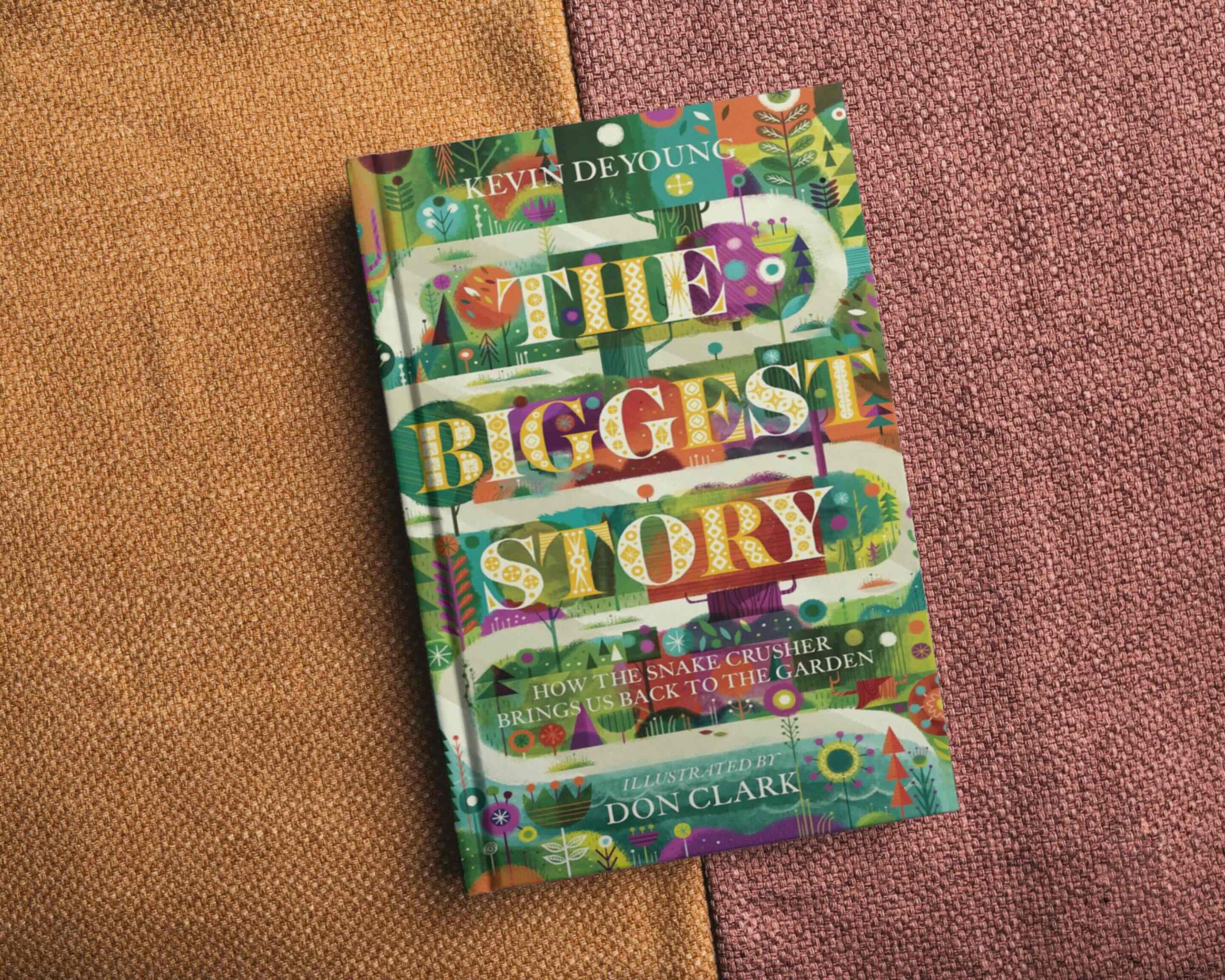
Author Kevin DeYoung, in this vibrantly illustrated children’s Bible, seeks to explain to kids (and adults) that the Bible is one large story made up of dozens of smaller stories to tell one unified rescue mission.
From the Garden of Eden to the new heavens and new earth, DeYoung teaches his readers about The Biggest Story and “how the Snake Crusher brings us back to the garden”.
Too many children grow up hearing the Bible as segmented stories meant to only inspire Christian morality and practical life choices. DeYoung, in his note to parents at the end of his book, explains this problem as “our kids can become acquainted with many Bible stories without ever grasping the Biggest Story that makes sense of all the others”.
What better time to “grasp the Biggest Story” than this Easter season?

Easter is wonderful to celebrate. But then after a day, a week, a month of celebration, life fades back into the monotony of existence and the journey of sanctification for the Christian continues to plod on.
The Pilgrim’s Progress by John Bunyan is one of my favorite stories. If you’ve never read it, I highly suggest finding a copy and enjoying it this summer. Dangerous Journey seeks to summarize the truths and length of The Pilgrim’s Progress into a beautifully illustrated picture book perfect for children to understand.
Dangerous Journey teaches young readers that the perseverance of the saints is a battle toward the Celestial City. It shows children the perils of this life, the temptations that threaten to lure us away from the path, and ultimately the glory of the Celestial City compared to the suffering of this present world.
Final Thoughts
During the Easter season, Christians celebrate Christ’s birth as a baby, His life as a pure and spotless lamb, and His substitutionary death on our behalf. May these 8 children’s picture books remind you and your families that “the time is fulfilled, and the kingdom of God is at hand; repent and believe in the gospel” (Mark 1:15).


