
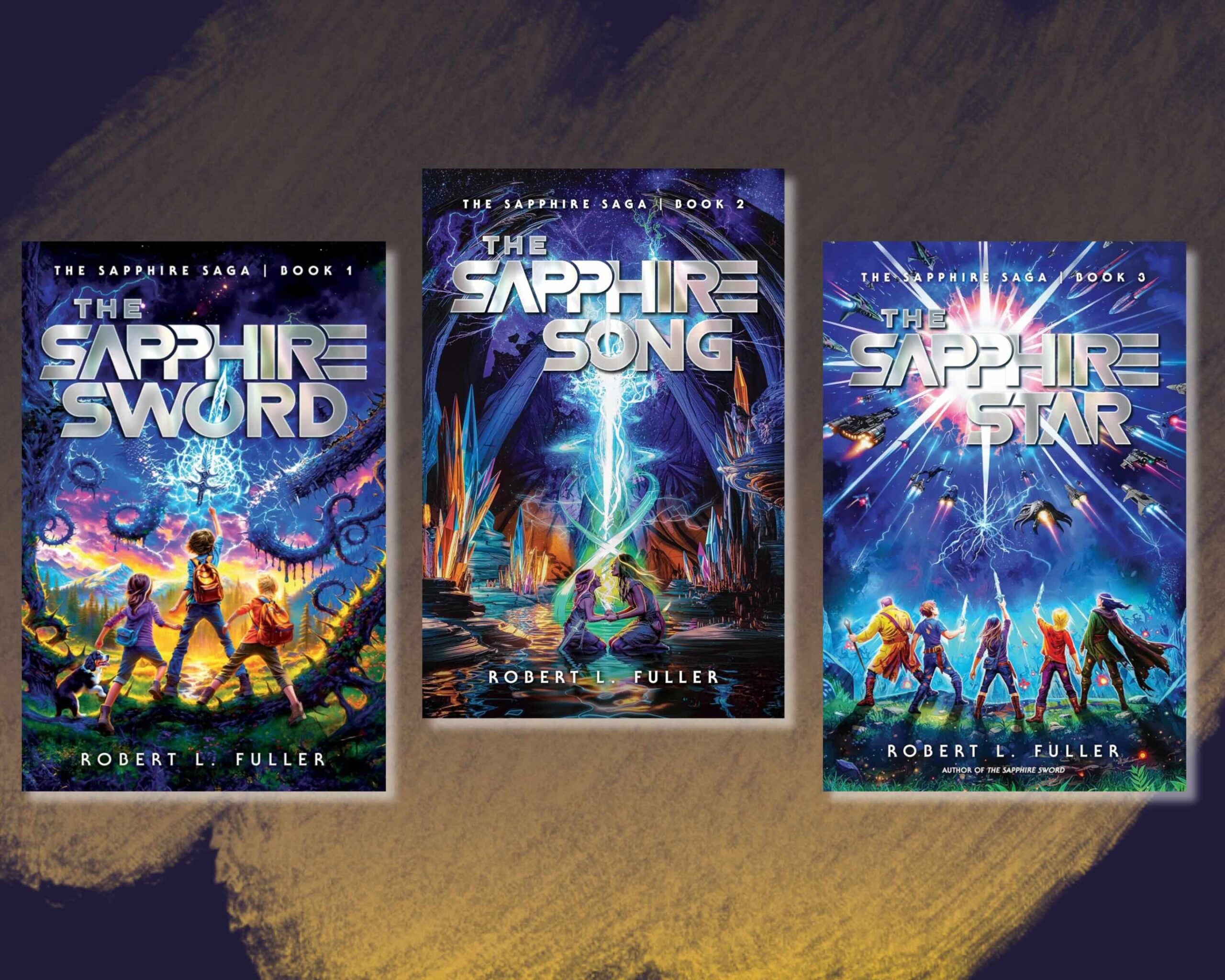
Imagine if The Wingfeather Saga collided with The Lion, the Witch, and the Wardrobe then launched into space where the main characters discovered they were aliens. The end result? You’d have The Sapphire Saga by Robert L. Fuller.
A few months back, I wrote an article explaining why kids need to read dangerous stories. Stories that are dangerous to the darkness, that is. And The Sapphire Saga by Robert L. Fuller (with the third book releasing in just a few months) invites its readers to experience dangerous truths that have the power to shatter darkness and burst forth the light.
Interested in this new series? Keep reading to explore the 3 dangerous truths The Sapphire Saga teaches its readers and why these truths should impact every believer.
As always, my thoughts on the Noteworthy Elements of The Sapphire Sword and The Sapphire Song (the two out of three books already released in The Sapphire Saga) are included at the end of this article.
Dangerous Truth #1: This World is not a Christian’s Home
The Sapphire Sword begins the story by introducing us to the O’Ryan children: Slugger, Flint, and Scout. Since their mother died years before, they’ve been living with their eccentric father picking cherries in the rugged mountains of New Mexico, experiencing their riveting (or not so riveting) education at home, and staying well away from the quarries that surround their property.
But when Scout, the only girl of the family and the littlest of the three, finds a wounded dog in the woods and rescues it from attacking snake-vines, the children’s quiet life gets flipped on its head. And the O’Ryan kids are faced with the fact that everything they thought they believed about their home planet is no longer true. Including their own heritage. Are they even human? Or are they actually aliens?
A point that really struck me as incredibly unique was when the O’Ryan children discover that not only is a pestilence invading their home planet, but they don’t even belong on earth. They’re children of aliens and foreigners on this planet, raised on earth but with the blood of another world pulsing through their veins.
The allegorical symbolism in this story sheds glorious light on the truth that for us as Christians, this world is not our home. We are foreigners, sojourners, aliens. And every day spent on this planet is spent in battling the pestilence that tries to destroy the truth we fight to protect. And until the day Christ calls us home, we’re aliens on planet earth.
Dangerous Truth #2: Darkness is Doomed to Die
Robert Fuller is a director and film producer who has written four books, with the conclusion to The Sapphire Saga (his fifth novel) releasing in a few months. On his website, Fuller describes himself as a writer passionate about sharing that “darkness is doomed and light will prove victorious”. After reading both The Sapphire Sword and The Sapphire Song, I can wholeheartedly agree that these themes resonate deeply within the bones of this sci-fi series.

Both the first and second books ended on thrilling cliff-hangers that only left me eager for the next story. But neither of those victorious (yet cliff-hanger) endings shied away from the painful, viscious truth that evil is wicked. The pestilence and the force that controls it aren’t weak, pathetic enemies the kids can simply conquer on their own. Taking down the pestilence means working together, fighting to save their own lives, and sometimes dying to save those you love.
In a culture that is rapidly seeking to define villains as “misunderstood”, The Sapphire Saga is refreshing in how it paints evil as, well, evil. The O’Ryan children are rightly afraid of the pestilence and those who are trying to spread it across the galaxy. But just because you’re afraid doesn’t mean you stop battling the darkness. It means you step into the front lines and face the enemy head-on.
Dangerous Truth #3: Kids Aren’t Immune to the Dangers of This World
The three O’Ryan children battle monsters, darkness, and their own failures throughout this series. But every trial draws them closer to each other and forges them stronger in the battle. They aren’t immune to the dangers of the planet and galaxy we all call home, but they aren’t going to shy away from them either.
Slugger, the oldest of the O’Ryan children, reminds me of Peter from the Pevensie family with his natural leadership abilities and understandable pressure to protect his siblings while also not taking too much charge. Slugger’s desire to mature into manhood clashes in heart-wrenching ways with his father’s desire to protect his son at all costs.
Watching Mr. O’Ryan gradually realize that Slugger needs to accept the role of the man he is becoming is emboldening and powerful. If the children we are raising now are going to grow into the next generation of mighty warriors for Christ and His kingdom, they need to begin realizing that the role they will play in this battle is anything but childish. Slugger’s example of growing into manliness is a powerful one.
Flint, the second eldest son, carries themes of Edmund Pevensie and Kalmar Wingfeather woven into this space-traveling genius. The trials his character undergoes in The Sapphire Sword forge him as a much stronger character for the dangers of book two, The Sapphire Song. Flint is constantly overshadowed by his older brother’s prowess in everything, but rebelling against his family only brings destruction and even greater ruin. Flint realizes this (though not at first) and the end result is a powerful, bonded relationship between him and his siblings.
And Scout? Imagine Leeli Wingfeather mixed with Lucy Pevensie wearing a spacesuit, rescuing a dog she nicknames ‘Robin Hood’, and battling an encroaching pestilence across the entire galaxy. This little girl captured my heart and brought humor, hope, and harrowing tension to every page of this series.
Scout’s point-of-view made me resonate so much more with the O’Ryan’s adventure. Her charm sprinkled across the pages of these first two books kept me locked-in through every bit of the drama surrounding this family. And watching her gentle love towards her brother, Flint, reminded me of Lucy Pevensie’s tenderness towards Edmund when the darkness tried to tear apart yet another family.
Final Thoughts (And a Quick Disclaimer):
If your child loves the plot of The Wingfeather Saga and themes of The Chronicles of Narnia, but longs for a tale set in space and across numerous galaxies, then The Sapphire Saga should be added to your bookshelves. The story focuses on numerous points-of-view throughout the tale, so both boy and girl readers should enjoy this adventure.
My least favorite part of these two books, even though I still recommend them overall, was undoubtedly the amount of “off-brand profanity” the dialogue was flavored with. The first book had more slang swear words than the second and my guess is that the author received feedback to lessen this kind of language in his second novel. While some families may be unbothered with these concerns, I have listed in the Noteworthy Elements below the number of times these words and phrases appear in the story for those families like mine who are more careful in this area.
Overall, books one and two of The Sapphire Saga delighted me. With realistic characters who face painful situations, a story plot that starts on earth and ends in a galaxy far away, and themes of courage, confusion, yet hope amidst the darkness… these books are perfect choices for your readers who want God-glorifying sci-fi stories.
If kids are going to be dangerous to the darkness, then they need to know and love dangerous stories. The Sapphire Saga is one of many great ways to start.
Noteworthy Elements in The Sapphire Sword and The Sapphire Song: I would recommend the first two stories of The Sapphire Saga for readers ages 12-14, though I did find myself enjoying them even as an adult. My largest concern with the story was the “off-brand profanity” used, so please prayerfully consider whether you find these stories appropriate for your family. There is no graphic violence, sexual content, or explicit profanity in the story.
- Violence: Slugger finds a drowned creature in a poisonous reservoir which he describes as “all hair and skin and muscle and organs had been melted away, leaving only bones bleached white and bubbling”.
- Profanity: The word “gosh” is used twelve times with two variations being “oh my ever-loving gosh” and “oh my heavenly gosh”. The word “heck” is used fourteen times, the word “geez” is used five times, and the word “dang” is used three times. The words “stupid”, “idiot”, “derfus”, and “nerdoid” are tossed around as insults a handful of times. The phrase “dad-gum” is used once and the expression “stinking” is used once. One of the O’Ryan kids exclaims “hallelujah” and someone calls the pestilence a “booger”. Mr. O’Ryan calls a dog a “little devil”. The words “hellish” and “hellfire” are each used once. Scout calls Slugger a “party pooper”.
- Spiritual: Scout asks Mr. O’Ryan whether their mom is “looking down on [them]” to which Mr. O’Ryan responds, “I sure hope so, sweetheart”. There is one reference to a seer and one reference to a dervish.
- Other: Slugger teases Flint that he’s “made of gas”. When the spaceship’s pilot says that “blasts of toxic gas are emitted into the atmosphere on occasion”, Scout responds with, “I told Slugger to quit it”. The pilot later reports “moderate case of flatulence found in eldest subject” to which Slugger replies, “Sorry, couldn’t hold it anymore”. The ship’s pilot when talking about emojis comments that “the smiley face is quite effective in communicating, as is the poop emoji”. Slugger describes the pool in their town as “teeming with microbes and toddler poop”. When Slugger is building an outhouse, Scout comments, “I will never understand why you think relieving yourself outside in a wooden hut is something to boast about” to which Slugger responds, “When push comes to shove, all you indoor-plumbing-cinnamon-twist-eating wimpsters will come running for help. Mark my words!”.


