
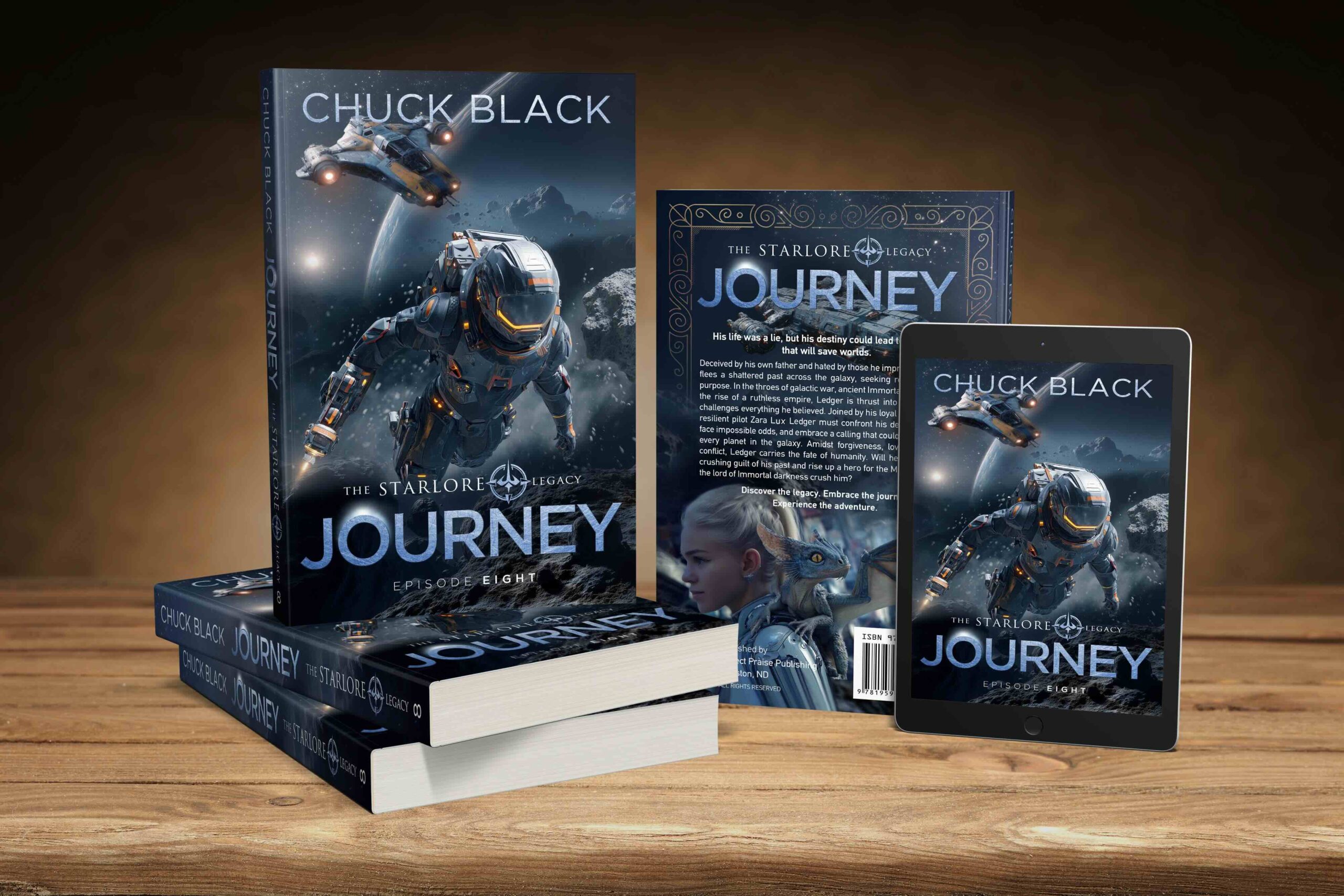
Out of the hundreds of books I read and review, it has been quite some time that a story gripped me as much as Journey, the eighth episode in the Starlore Legacy by Chuck Black. I read the book entirely within one day, trying to convince myself to move on to other subjects… but unable to put it down.
With a riveting plot, intergalactic setting, themes that span time and space to be relevant to modern-day Christians, and characters whose charm and humor made me laugh out loud at numerous points throughout the story, Journey is one of a few select tales that leaves me longing for more, and eagerly awaiting the next book in this series.
Chuck Black’s stories never cease to thrill me. Journey should be the next title on your shelf.
Reflection #1: Gospel-Centered Themes Empower Christ-Driven Readers
I grew up loving Chuck Black’s Kingdom Series and Knights of Arrethtrae. His morals and themes so prevalent in his fantasy stories I now see carried into his science fiction series. Themes of bravery when facing the darkness, courage when battling past mistakes, and dedicated servitude when fighting to spread the message of Jeshu to the ends of the galaxy permeate Journey and the seven other stories before it.
Personally, I don’t enjoy science fiction like I do other genres such as fantasy or historical fiction. Yet somehow I still find myself absolutely entranced with Chuck Black’s writing style, clear gospel messages, and characters who choose pain and courage over submission and apathy every time.
For readers who love the themes and characters of Chuck Black’s previous series, the Starlore Legacy (even with its science fiction setting) won’t fail to entertain you. (My Noteworthy Elements on the content of Journey are listed at the end of this article.)

Reflection #2: In A Galaxy Far Far Away, We Can Learn from It’s Battles
Journey follows the story of young Ledger, a former Keeper Defense Force agent and staunch enemy of the rising Jeshuan rebel group. But when Ledger’s entire life is proved to be a lie, he runs to the distant planet Abaria to escape his heritage and those who pursue him. But the son of Ell Yon, Jeshu himself, has a plan for Ledger’s life. And Jeshu’s hand reaches to every point of the galaxy.
Journey imagines the story of the Apostle Paul set in a distant galaxy where wicked Lord Dracus fights for total control of the Raylean people. But Jeshu, the son of Ell Yon, has a plan to reclaim all the nations of the world from the poison of Lord Dracus’ control. And nothing will stop Jeshu’s mission.
While reading Journey, I found myself loving the reimagined story of the Apostle Paul’s persecution on the Christian church, miraculous regeneration, and total commitment to Christ and Christ alone. Watching young Ledger’s transformation from staunch enemy to loyal follower rekindled my longing for heaven and final victory.
Reflection #3: Honoring Previous Generations Empowers the Family
Journey focuses mainly on the third generation of the Starlore family. I love seeing how the decisions Ledger’s parents and grandparents made shaped the direction of the galaxy and the course of Ledger’s own life as well. In a culture that tends to value youth over old age, it is refreshing to watch author Chuck Black pay homage to the ancestors who went before Ledger and paved the path he now walks on.

Reflection #4: A Tale Enjoyed by the Entire Family is Worth Exploring
With how segmented our modern culture is, the fact that a story like Journey (and the entire Starlore Legacy) can be loved and appreciated by readers of all ages testifies to the time and effort Chuck Black has poured into ensuring his stories can be loved by multiple generations.
Close friends of my family eagerly await each new release of the Starlore Legacy audiobook so that they can continue exploring the adventure as a family. Intentionally creating family moments around gospel-centered stories like Journey and the rest of Chuck Black’s books forges powerful and lasting impact on every generation.
If you’re looking for a story that younger readers are enamored by, teen readers resonate with, and adults praise so highly, the Starlore Legacy should be the next series on your reading list.
Final Thoughts (Because Your Kids Really Need to Read This Story):
Chuck Black, a former F-16 fighter pilot and tactical combat communications engineer for the United States Air Force, has spent the last several years of his life writing God-glorifying allegorical stories for children and teens. Journey, the eighth installment of the Starlore Legacy, releases on March 24th and is currently available for preorders from Perfect Praise Publishing.
Chuck Black is the author of over twenty novels for children and teens ranging from medieval-inspired fantasy settings, modern day spiritual warfare, and finally the Starlore Legacy set in the distant reaches of a sci-fi galaxy. I cannot more highly recommend any of his stories to readers of all ages.
If you, as a parent or grandparent, are looking for stories for your children and grandchildren that will encourage their faith, motivate their bravery, and show them that living for the King truly is worth it, then clear space on your bookshelves to fit Chuck Black’s stories.
Noteworthy Elements in Journey: There is no sexual content, graphic violence, or explicit profanity in this story. Because of the science-fiction setting and redemption themes so powerfully woven throughout the tale, Journey will probably be best appreciated by readers ages 12-14, but the story is beloved by older teens and adults as well.
- Violence: When attacked at an eatery, a man’s death is described as “The energy discharge ripped clear through the man, leaving half of a smoldering corpse that fell to the ground with a thud”. When held captive by enemy forces, the enemy threatens Ledger, saying, “I will cut your tongue out and dismember you piece by piece before I let you die”. The threat is never followed through.
- Profanity: The expression, “shucks”, is used one time.


