
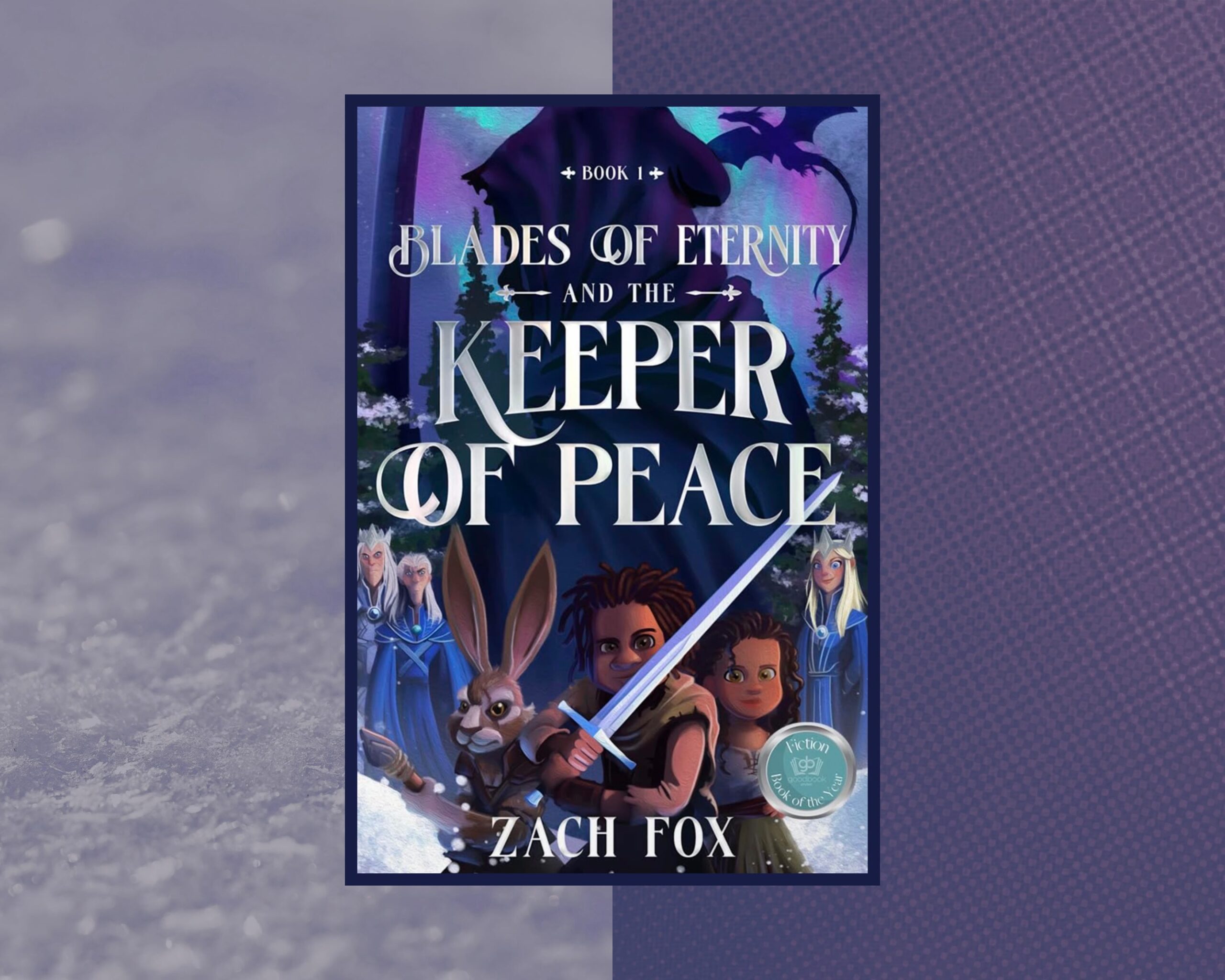
I haven’t read a children’s fantasy book in a long time that thrilled me like Blades of Eternity and the Keeper of Peace by Zach Fox. The entire time I was picking up threads of Narnia or Natalia woven through the characters, world, and plot.
I will say, though, that I went into this book with a couple of hesitations. First, I had heard a reviewer mention how the children talk back to the adults quite often throughout the books. And second, could a book claiming the comparative titles of Narnia and The Green Ember really live up to either of those stories?
Turns out my hesitations were completely unfounded.
First Things First
I recently finished Blades of Eternity and the Keeper of Peace by Zach Fox. It totally blew my expectations out of the water. I had heard that the story drew parallels between The Chronicles of Narnia and The Green Ember, but it was so much fun to see those elements celebrated in every page of that book.
Between talking animals, kingdoms for every season, and the desperate hunt for the Keeper of Peace, I loved the allegorical elements that author Zach Fox brought into this book, and I love the messages it teaches to young readers.
My favorite part of Blades of Eternity and the Keeper of Peace was how the author challenged his young readers to question the actions and decisions the characters made. Like Edmund from The Lion, the Witch, and the Wardrobe and Picket Longtreader from The Green Ember, Zach Fox’s characters aren’t picture-perfect children leading happy, peaceful lives. The reviewer was correct— they do talk back to the adults, they do make rash decisions, they do fail over and over and over again.
But that’s not how the story ends.
So here are three questions from the story that I think are valuable for every child to ponder, and invaluable for guiding family conversations if you decide this is a tale to add to your bookshelves.

1. Can an Inanimate Object Atone for Sins?
One of the neatest elements of plot development Fox created (in my mind) was the idea of “beating posts”. At the end of every day, the characters literally beat posts as payment for their sins. Once a year, those posts are burned as a symbol of one’s sins being removed.
Drawing parallels to the scapegoat of Leviticus 16:9-10, Fox asks his child readers whether an inanimate object is a substitute valuable enough to atone for your sins. Can justice be satisfied if you hurt a friend then take it out on a post? Can sins actually and fully be atoned for by punishing an inanimate object? I found this parallel fascinating and thought-provoking for kids and for teen readers.
I am especially interested to see where Fox takes this allegorical element in his later books, but the development he showed in book one was incredibly fascinating.
2. Does Mercy Outweigh Justice?
To be perfectly honest, the character Mel concerned me in the beginning of the book. Two chapters in, he’s disturbing a political council with his brazen attitude and shushing adults in their seats. I was pretty certain at that point the author was going to let Mel get away with misbehavior, but author Zach Fox certainly had other ideas.
Throughout the story, Mel learns the meaning of true leadership, but mainly through seeing the negative effects of bad leadership. From arrogant young men like the Prince of Winter to brutal fools like the Prince of Autumn, Mel realizes through the council of older, wiser mentors that mercy is a virtue every leader should strive to uphold. And when mercy is abandoned? Kingdoms go to war. A hard lesson for a young ruler.
There were definitely scenes where the main character, Mel, failed like any main character does. But the story heavily contrasted the themes of mercy and justice, rash anger and patience, and trust and betrayal. Mel was a great example of a young man overcoming prejudice and rash anger to learn that mercy is one of the strongest virtues a leader can possess.

3. What Does Rash Anger Ever Achieve?
Throughout the story, we see the character of Mel struggle with his temper when faced with Azazel, the Prince of Winter. I originally thought that the author was going to justify Mel’s anger in the face of Azazel’s irritating personality, but the author did the complete opposite of that.
Through the wise mentorship of older friends, the companionship of Vashti, and the guiding direction of the Lamb, Mel learns that mercy creates a stronger and more lasting impact than anger ever could.
Zach Fox, in terms of children’s fantasy, is one of the strongest plotters I’ve read in a while. I was thoroughly engaged in every chapter and he even concluded the book on a horrible cliff-hanger that’s sure to keep pulling readers into his series. His twists were realistic and appropriate to the plot, his characters made choices consistent with their roles, and his world was such a unique one! I especially loved the nod to frozen Narnia through the King of Winter and his kingdom. But the morals and lessons Fox introduced to young readers were my favorite parts of Blades of Eternity and the Keeper of Peace.
Closing Thoughts:
For readers who love the themes of The Chronicles of Narnia, the characters of The Green Ember, and the settings of both of these beloved stories, you will want to find a copy of Blades of Eternity and the Keeper of Peace. I am excited to enjoy the next adventure in this series and I can’t wait to see where author Zach Fox takes this story.
Aside from a few minor concerns I’ve noted below in the Noteworthy Elements, the main thing parents should know about this story is that a romantic love triangle does exist between Mel, Princess Eva, and another female character named Vashti. It was written in a way that I didn’t find to be inappropriate for younger readers, but I’ve noted specific sentences or phrases that may concern some parents.
Altogether, I would probably place my personal rating at ages 12-14, the same age I recommend The Green Ember for individual reading. While Blades of Eternity and the Keeper of Peace (like The Green Ember and The Chronicles of Narnia) would certainly be a great family read-aloud, younger readers may find some parts of the story harder to track if reading on their own.
If the series continues to be as good as the first book, I’ll be delighted to add it to The Library alongside dozens of my other favorites.
Noteworthy Elements from Blades of Eternity and the Keeper of Peace:
- Sexual Tension: When Vashti sneaks into the traveling wagon and is discovered during a border inspection, the guards accuse Mel and his friends of trafficking. No explicit details are given. As referenced above, a romantic love triangle is hinted at between Mel, Princess Eva, and Vashti. None of the descriptions are sexual, but this is something some parents may want to know for their young readers. Mel makes a reference to wanting to brush Eva’s face with his hand and enjoying when their hands touch.
- Profanity: Brutus uses the expression “blimey” one time. Mel calls the Kingdom of Winter a “frozen hell” one time.
- Spiritual: There are a few references to the priests at the temple who burn the posts once a year to symbolically atone for the people’s sins. An enemy soldier calls Vashti a “shady little witch”.
- Other: Mel calls Azazel’s hair as “white as bird’s poop” and later refers to the people in the Kingdom of Winter as “frozen turds”. Both of these expressions are used only once and are easy to skip if reading aloud. In the beginning of the story, the Princess of Spring insults the Queen of Autumn with phrases like “dopey carrot-topped ostrich” and “the old wart”, but is later corrected for her rudeness. A large part of Mel’s character building focuses on how he treats the Prince of Autumn, Ulysses. In the beginning of the story, Mel insults Ulysses by saying “you are as dumb as you are ugly” and asking him how he can “muster the courage to show that bulbous mess [he calls] a face”. The horse, Nag, after wishing out loud that he could eat one of palace cook’s whoopie pies, tells Mel to “shut [his] whoopie piehole”. Azazel tells Mel to “shut your mouth, you shady wart”. Azazel calls himself “stupid” one time.


